Planning the Project Budget
Published: 2009-02-01
Last updated: 2022-03-20
Following the project planning process, we continue with planning the project budget, sometimes called project budgeting, in 3 steps.
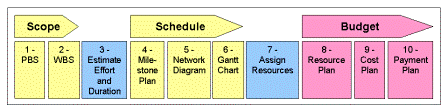
The three steps are: finalizing the resource plan in form of manpower histograms and similar plans for tools and material, deriving the cost plan and determining the plan of how the project gets paid for.
Now, we combine all this information with our project schedule, i.e. network diagram and Gantt chart. To each work package we assign the resources in terms of
- manpower: how many people, on what level of skills, with which work load
- material: how much of what kind of stuff
- tools: which machinery with what characteristics.
The immediate result of assigning resources to all the work packages will be the resource plan which basically shows when we need whom, what material, and what tools. Another result we obtain is the so-called manpower histogram. It focuses on people only: how many people do we need in which area of skills, on what level of skills, and on what level of work load.
Step 8 – Resource Plan
The following diagram shows an example of a manpower histogram of a project in which we need the contribution of electrical engineers. The horizontal line reflects the time line in weeks (of 40 working hours, each; work load: 100%), the vertical line indicates how many engineers are supposed to work on that project in which week, e.g. 40 engineers in weeks 32, 33 and 34.
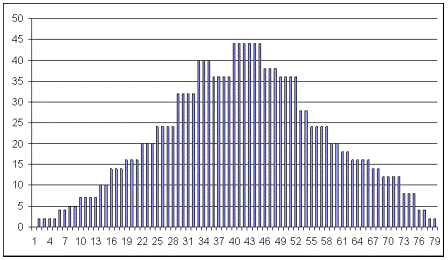
We obtain similar diagrams for all other skill areas and levels and even for the tools and machines we need to use.
Step 9 – Cost Plan
If we now only add the information of hourly rates for the people working in our project, for the tools we need, and the cost of material, we immediately get the cost plan for the project. The cost plan shows the accumulated cost or planned cost of the project with reference to the project time line.
Step 10 – Payment Plan
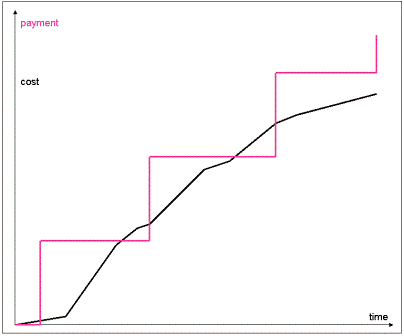
With a finalized cost plan, we know when we need to provide how much money in order to cover those costs. Since we usually have a customer-contractor relationship, coverage of the cost is taken care of by customer’s payment. So, from the accumulated cost plan, we can derive a payment plan. From the customer’s perspective, this payment plan translates into the project financing plan: On basis of the payment plan, the customer is able to determine the overall project budget, and what portions of that budget are needed at what time to fulfill the payment plan.


In case the project is about developing, manufacturing, and selling a product, the situation is similar: then, we usually need a sales plan instead of the payment plan.
If the project is company or organization internal, then we could interpret the situation as being an informal customer-contractor relationship. I.e., the informal customer could be the CEO of that company or organization, and the informal contractor’s role could be plaid by one special department.
35+ templates, tools, and checklists in one set
To save you time in your daily work as a project manager, I packaged more than 35 project management templates, tools, and checklists into one zip file.
- You un-zip it, and you get all items in formats you can edit to your requirements.
- They strictly contain only standard functionality and no macros or other code.
- You are allowed to use your logo.
or click here for more info.
Traditional PM
Learning Path Navigation
|
|
|
Return to Project Planning
Return from Planning the Project Budget to Home Page
|
|
|
Your Comments
Have your say about what you just read! Leave me a comment in the box below.