- Home
- Project Portfolio
Project Portfolio Management
Published: 2009-07-03
Last updated: 2022-03-18
What is project portfolio management?
Virtually every organization or enterprise faces the situation to manage several projects at the same time; let us call it our "portfolio of projects".
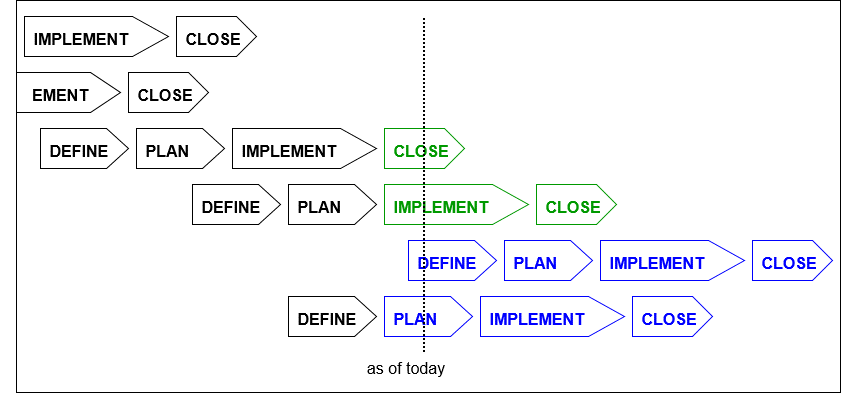 In a typical project portfolio, some projects are already closed, others are in implementation or closure phase, while some might still be in definition or planning phase.
For each individual project, the importance of project management is almost self-explanatory and the benefits of project management are obvious. So, we only have to train our human resources in the discipline of project management in order to improve our ability - as an organization - to work on a higher number of projects more successfully.
Is that right?
We do not think so.
Resources - especially the well trained - are significantly limited so that we cannot undertake all projects we would like to have. Usually, several projects have to share the same resources. This is like an internal competition that – in most cases we have seen – does more damage than good.
We reflect on the following questions.
- Which projects shall we carry out and which ones drop or postpone?
- How are we prioritizing projects?
- How can we structure our organization to optimize the management of resources and thus enable us to work on a higher number of projects?
- What processes support the management of a portfolio of projects?
- How can we measure our organizational ability for managing multiple projects?
- What can we do to make sure that we have the right people in the right positions in order to achieve successful projects?
(1) Project Selection
The most important question in project portfolio management is
"How can we make sure that we are doing the right projects?"
This question leads us into the area of strategy development. More precisely:
- How can we identify the right projects, i.e. those which are supporting our strategy or are in-line with our strategy?
- How can we evaluate and prioritize, initiate, and monitor them?
In sub-sections Project Selection and Project Portfolio Dashboard, we follow up on these questions and present some possible answers.
(2) Project Prioritization
Any medium size to large size organization usually has a clear strategy in place that defines which of its divisions or departments acquire and undertake what kind of projects. Thus, the selection of the right projects is given by the strategy. For example, a large construction company could have divisions like
- private housing,
- office buildings,
- manufacturing buildings,
- etc.
For each of these divisions or departments it is clear what projects they pursue.
They need to prioritize their projects on division or department level. This, we follow up in our sub-section on Project Prioritization.
(3) Multi Project Management
There are different potential organizational setups of our resources to optimize project portfolio management. Since resources are limited we need to find the best one for each project under a given set of criteria. In this context, we introduce the concept of a project management office.
We discuss these aspects in sub-section Multi Project Management.
(4) Program Management
In case we have to deal with a number of similar projects we can pool or combine these projects into a program of projects. In that sense, program management is a special application of multi project management.
In sub-section Program Management, we present the characteristics of managing programs of projects.
(5) Project Portfolio Dashboard
Executives and higher level management of a project based
organization needs a tracking system that allows for monitoring and
controlling of multiple projects. It certainly depends on the key
performance indicators (KPI's) of the organization what that system will
look like. What we certainly need is:
- Overall picture of all projects;
- How are our projects doing in terms of scope?
- How are they doing in terms of adhering to schedules?
- How are they doing in terms of meeting their budgets?
- Necessary and deployed resources;
- Risk exposure.
In sub-section Project Portfolio Dashboard, we present some useful examples of what we could use.
(6) Knowledge Management
Emphasis here lies on the aspects of a learning organization. Primarily, the organization's members, the people do the learning. The organization "learns" through its members:
- They re-organize their structural setup (including merging with or acquiring other organizations);
- They change their processes or create new ones in order to adapt to the changing needs of continuous learning of its individual members.
This - almost permanent - change of organizational structures and processes has to be managed and facilitated.
We explore these aspects in sub-sections Knowledge Management and Learning in Organizations.
(7) Project Management Information System
Although integrated into knowledge management, we discuss the IT aspects of project portfolio management separately. An information system that is supposed to support the management of multiple projects comprises a software environment for
- planning and controlling projects,
- collecting and filing data relevant for effort estimation and risk evaluation,
- as well as a data base of templates for the most important project reports.
In sub-section Project Management Information System we present the most important elements of such a system. For general aspects of controlling a portfolio of projects, please refer to sub-section Project Portfolio Dashboard as well.
(8) Project Management Maturity Model
Getting an organization ready for project portfolio management is a project itself that needs a goal that is SMART. Here, we emphasize the fact that this goal shall be measurable: How can we measure to what extent an organization is prepared to manage multiple projects? Before answering this question we need to look into methods how to assess individual projects.
The sub-section Project Management Maturity Model summarizes the basics of project assessments and an organizations ability to manage multiple projects.
(9) Project Management Career, Training and Development
Ultimately, real people manage and carry out all our projects and the
related work. Thus, in best practice project portfolio management, we
need to care about how we want to hire and retain good project managers.
Key elements are:
- A structured approach to the development of project managers that combines training with learning by doing and fits to the career model.
- A corresponding project management training system that offers a project management curriculum of seminars, workshops and training programs.
- A project management career model, including a salary and incentive system, keeping in mind that it is not only money that motivates us: sometimes it is publicly expressed recognition or just a small gift.
Return from Project Portfolio Management to Home Page
|
|
|
Your Comments
Have your say about what you just read! Leave me a comment in the box below.