- Home
- Closure
Project Closure
Published: 2009-04-20
Last updated: 2022-03-16
Project closure is the last phase of the project management process. Upon the end of implementation phase, preliminary acceptance of the project result is accomplished; yet minor items may still be open, summarized on a list of open points, LOP (sometimes also referred to as list of open items).
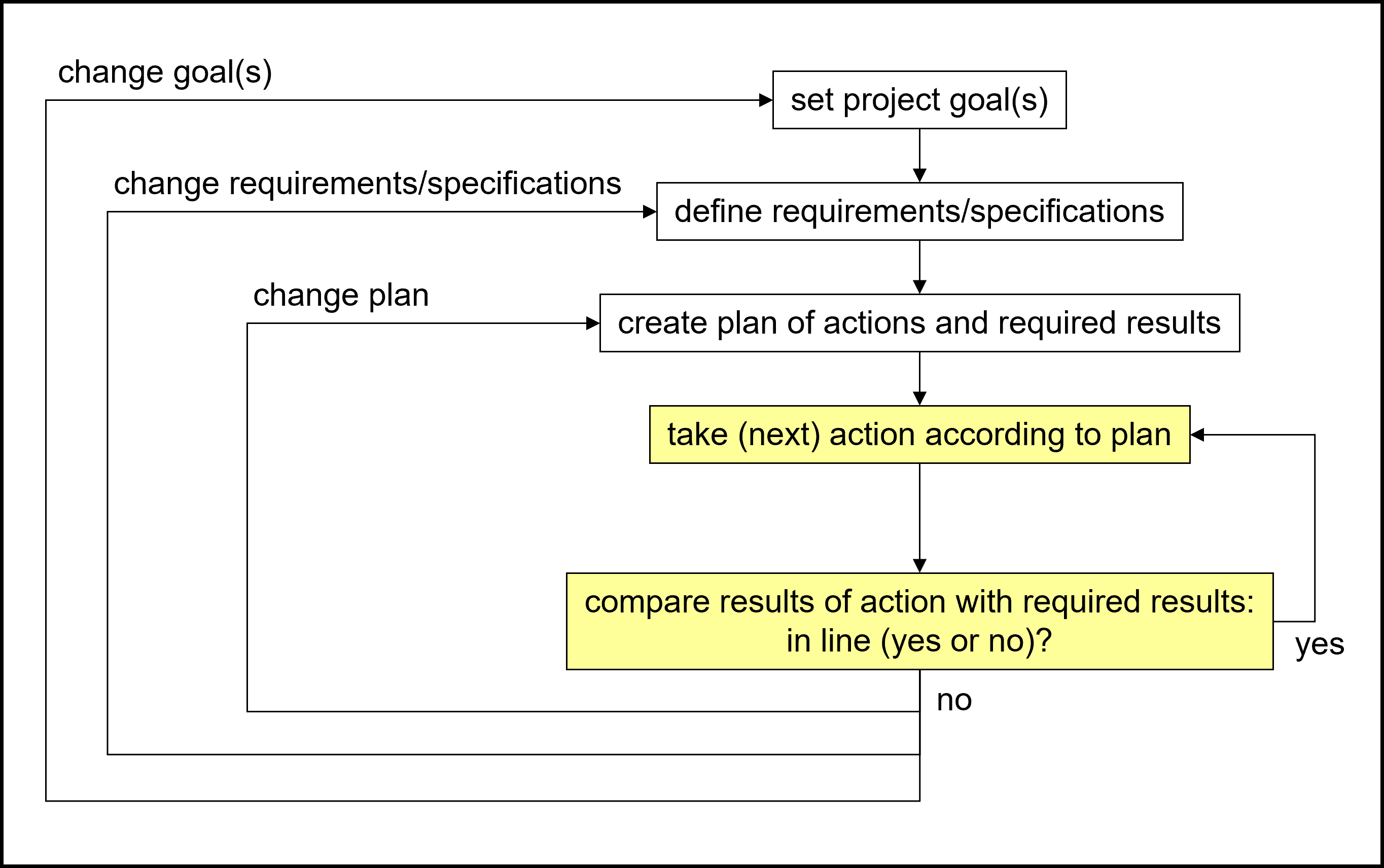

Still following the basic project control cycle, we continue applying all the tools of the implementation phase in this last phase, until the LOP can be officially closed.
Our major activities to close the project phase are:
- resolve all those open points of the LOP
- support settlement of open claims
- prepare the final presentation of the project results
- get final acceptance of the project results
- handover the project results to the customer and/or user, combined with an official celebration
- close all project controlling tools
- complete and close all reports or documents
- generate final project reports for your organization, the customer, other stakeholders
- call for feedback from team members, your control board, the customer, and other stakeholders
- carry out a lessons learned workshop, including a final risk assessment
- handover to the team that takes care of the warranty period or further customer support
- have a party with your team
- release resources and support them to find new assignments
- close all project accounts and carry out the final project calculation
Since this list could serve as the backbone of a project closeout checklist, as we offer it in the section Free Downloads, let us highlight some of these points here, some others in the sub-section Project Management Closeout.
If the critical chain method was used, we need to evaluate if it had the desired results in terms of avoiding delays or cost overruns. For that, we can use the same checklists.
Settlement of claims
In the section Project Implementation, we suggest to enter discussion and settlement of claims as early as possible in order to take pressure off the project closure phase. Where this is not possible we have to do it now. If the contract contains methods of ADR (Alternative Dispute Resolution) we follow their natural escalation. In case we have to pursue arbitration or court procedures we can try to cut these open issues from the remainder of the project in order to enable a formal completion of the project. Otherwise the project cannot formally be concluded until the open claims are settled by arbitration or court decision. Please refer to sub-sections Contract Management, Project Claim Management and Project Claim Analysis.
Feedback from project stakeholders
The feedback of team members, the control board, the customer, or other stakeholders has different facets.
One area of interest is how we worked together: soft facts. This will cover aspects of team work and group dynamics of the core project management team, and aspects of leadership behavior of the project manager or the control board members. Leading questions for these discussions could be (but are not limited to):
- How did our team develop over time?
- How did we deal with complex situations and problems?
- How did we deal with crisis situations?
- How did we deal with conflict?
- How did we manage difficult negotiations?
- How successful and effective was the facilitation of our meetings?
- How successful was our coaching or mentoring of team members and colleagues?
- How successful was our virtual team work?
- How did we handle the aspects of cross-cultural communication?
The other area of interest refers to the satisfaction of main stakeholders with the project results and the project management processes: hard facts.
- We can ask the customer / end user of the project result for their satisfaction.
- We can ask the control board members for their satisfaction.
- We can ask our core team members including the sub-project managers and the project manager in order to obtain their levels of satisfaction.
For feedback about the soft and hard facts, we can conduct interviews or formalized feedback (e.g. questionnaires), in form of customer satisfaction and team satisfaction surveys. Then, we use the survey results as additional source for our lessons learned in project closure. Just make sure that you keep all personal feedback strictly confidential, only within the group of involved people, or make it anonymous.
Lessons learned workshop
Lessons learned workshops have two-fold benefits:
- They support their participants' professional and personal career development in terms of project management, leadership, team work, knowledge, skills, and experience.
- They improve the knowledge base of the organization(s) the participants belong to, in the area of project management.
The first point seems to be clear. For the second one let us look at the following example.
We are a company that provides photo-voltaic (PV) power stations on a turn-key basis in Southern European countries. Currently, we have 7 different projects under contract of which 4 are in project closure phase. Over the last 10 years we successfully completed 16 similar projects in that same geographical area. For another 8 projects of that kind, we are in planning phase.
Each PV power station includes one or more arrays of 10s or 100s of PV panels which we manufacture in our own factory in an Asian country. Thus, all our projects contain a work package like "deliver X number of PV panels of type Y". Usually, these work packages are on the critical paths and correspond to significant payment milestones of those projects, sub-divided into different delivery batches.
For each project we apply risk management as described on this web site. In all our risk analysis workshops, we find the risk of "missed payment milestone because of a delayed delivery batch of PV panels by 30 days". For new projects, our experts continuously face the problem of realistically estimating the probability that e.g. such a delay of 30 days could occur.
Thanks to the knowledge management process in our company, we have a project management information system in place which contains a risk data base that is fed by lessons learned of already completed projects (16 + 4). Hence, our experts can apply a little bit of mathematical statistics to that information stored in our risk data base and combine the results with current data of our manufacturing capacity, raw material supply, and their own expert opinion.
This story illustrates how the company as a whole could benefit from lessons learned workshops, if the idea of a project management information system is pro-actively supported.
Conclusion of Project Closure Phase
The official declaration "project goals successfully achieved, final acceptance issued" concludes the project closure phase and the project.
35+ templates, tools, and checklists in one set
To save you time in your daily work as a project manager, I packaged more than 35 project management templates, tools, and checklists into one zip file.
- You un-zip it, and you get all items in formats you can edit to your requirements.
- They strictly contain only standard functionality and no macros or other code.
- You are allowed to use your logo.
or click here for more info.
Traditional PM
Learning Path Navigation
|
|
|
Return from Project Closure to Home Page
|
|
|
Your Comments
Have your say about what you just read! Leave me a comment in the box below.