- Home
- Definition
Project Definition
Published: 2009-03-15
Last updated: 2022-03-07
The main task in project definition phase is to set clear project goal(s), so-called SMART goal(s), together with requirements or specifications in terms of scope, schedule, and budget. Only this enables goal-oriented planning in the following phase. We also introduce the concept of stakeholder management and stakeholder analysis.
Every project starts as an idea how to solve a problem. An individual and her family, a company, or a government entity wants to create something, the desired project result that solves their problem. Maybe, it is the first home, a new IT system, or a bridge across a mile wide river. At this point, at the very beginning of the project, we have only vague ideas about how to achieve the solution or project result. We do not yet know further details about what the result will look like or how we could get there.
As we explain in section Project Management Process, we want to be in control of our project at all times. In implementation and closure phase, this means being able to compare results of action with required results. Therefore, we need a project plan that contains all necessary actions and required results. Moreover, we only can create such a plan if we know enough details about the project goal and requirements or specifications of the desired project results.
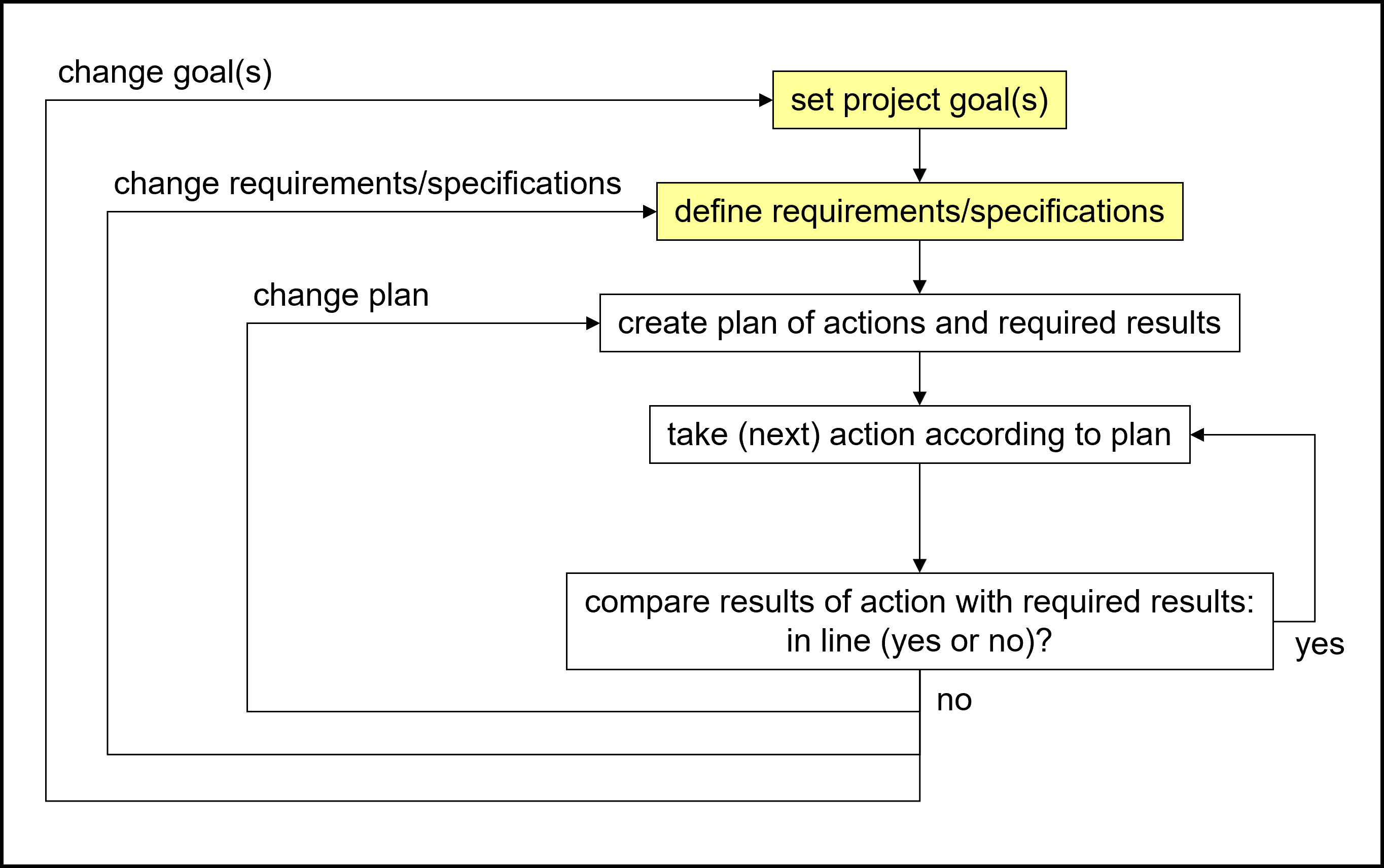
We have to refine our vision into a clear goal, and then, break down this goal into sub-goals and sub-sub-goals, until we can define even detailed requirements or specifications our desired end result has to fulfill. In order to support this process of defining more and more detailed characteristics of the project result we need to follow certain criteria of how to setup goals, requirements, or specifications: they need to be SMART.
SMART Goals
We call a goal being SMART if it is
S pecific,
M easurable,
A ttractive,
R ealistic, and it's
T imeline is clear.
Project Charter
Obviously, we need to have a team working on those tasks of project definition phase, like developing SMART goals, etc. This team needs a clear assignment. For that purpose, we create a project charter.
Who can help to define the goals, sub-goals, requirements, and specifications of a desired project result? We must ask those who have a stake in the project.
Stakeholder Management
Stakeholders are individuals or organizations who
• have interest in,
• or are affected by
the project results or project activities.
Stakeholders either are human beings or are represented by human beings. So, stakeholder analysis and stakeholder management call for the full range of soft skills, such as inter-personal communication, facilitation of teams and teamwork, or conflict management, to name just a few.
For assistance with conflict management and effective communication refer to Communication and Conflict.
Who is responsible for stakeholder management?
If you are the project manager then you are responsible for stakeholder management in your project. Since you are not alone working on your project you will involve your team members, your sub-contractors (if you are in the role of a customer), or your customer (if you are in the role of a contractor or sub-contractor).
In case your project is setup on basis of a typical customer-contractor relationship and you are in the role of the contractor, your company’s organization most likely provides a clear differentiation of responsibilities that could be as follows.
Key account managers and sales managers are responsible for project definition and planning phase. They pick up the customer’s idea or vision of a new project, collect a request for proposal or quotation, prepare the proposal, submit it, carry out the negotiations, and sign a contract. Then they hand over to you, the project manager, who is responsible for project implementation and closure phase. It is clear that this handover of responsibilities is a critical transition with a high risk of lost information. We can decrease this risk by adhering to a clearly defined process.
Stakeholder Management Process
The stakeholder management process looks as follows.
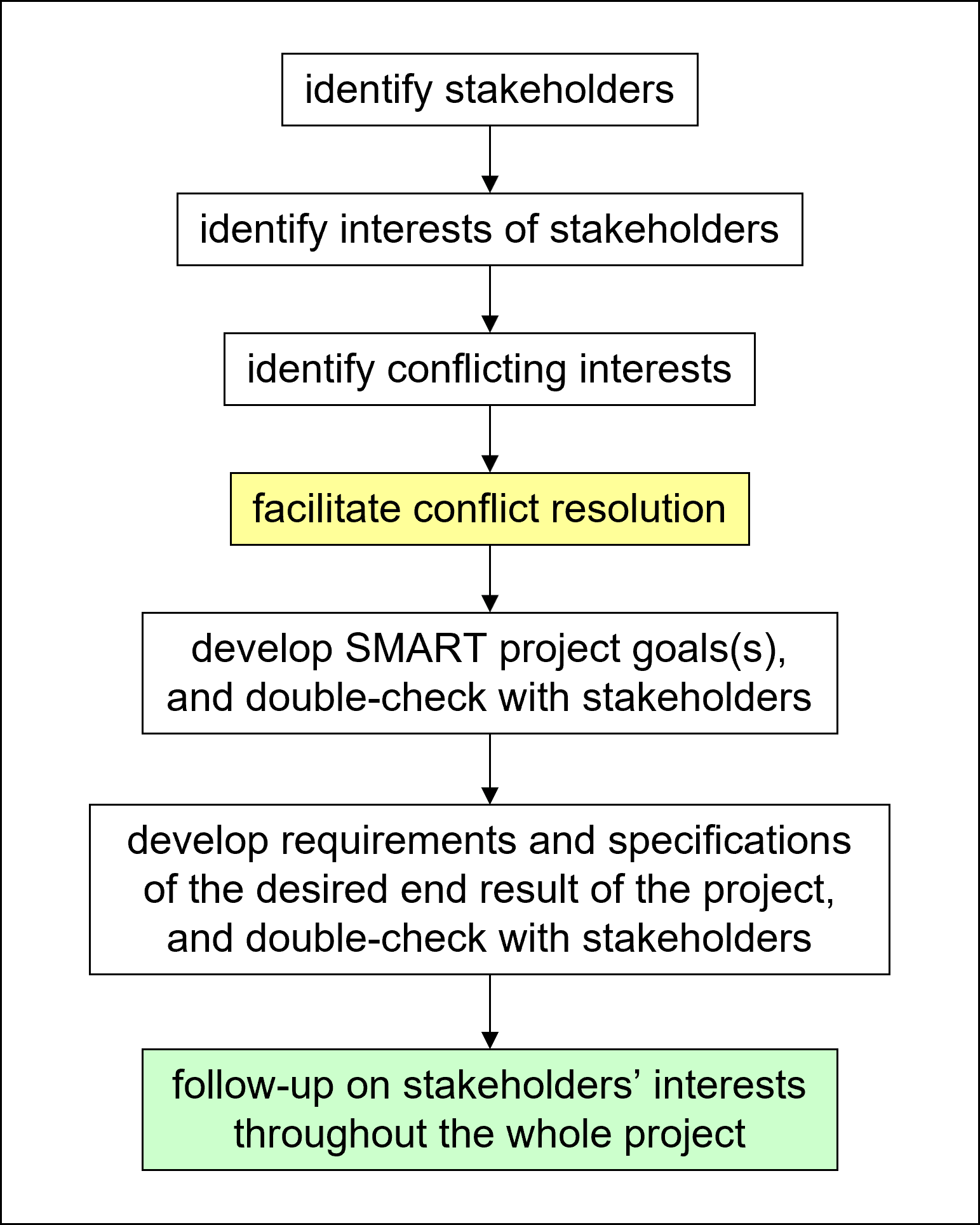


Identification of interests and especially the resolution of conflicting interests are definitely not as easy as it is written down here. There are just too many examples of hidden agendas, or even deep conflicts between different stakeholders that terminate projects before they even start. We emphasize again that for these tasks, those who have to accomplish them need the full set of soft skills. For the further planning activities it is essential to follow-up on the stakeholders’ interests throughout the whole project. Moreover, these interests have to be managed in a way that we can avoid unjustifiable changes of goal(s), requirements, or specifications in later project phases. In sub-section Stakeholder Management, we present a useful method and some tools that support stakeholder management.
Requirements and Specifications
The development of requirements and specifications of the desired end result of any project needs expertise.
Just take the example of planning and building a customized home. We need expertise in areas like architectural design, civil engineering, electrical engineering, piping and plumbing, heating and cooling, interior design, etc.
Thus, we form a team of experts, often consisting of Business Analysts, who will take over the development of requirements and specifications. The project manager’s responsibility is to facilitate the team work of all those experts.
In larger projects it is useful to develop requirements and specifications in form of functional descriptions. We just describe on the functional level what we expect the end result of the project to do, rather than defining all the characteristics of that result.
Project Management Handbook
In project definition phase, it is also appropriate to start the project management handbook of a new project. This document will serve as a virtually complete compendium that contains literally everything that corresponds to that project.
more on the Project Management Handbook
Project Contract Structure
In most projects an organization wants to undertake, they need support of other organizations, companies or legal entities. Therefore, we need to know what basic project contract structures are available so that we can choose one that fits to our project situation. It is best practice to define the project contract structure as early as in project definition phase. Here you find more about project contract structures.
Conclusion of Project Definition Phase
We consider the finalized project goal(s) together with the requirements and specifications of the desired project result being the most important prerequisites for further project planning. In projects with a typical customer-contractor relationship the customer will conclude the project definition phase by officially issuing a request for proposal or quotation. This triggers the start of the project planning phase.
35+ templates, tools, and checklists in one set
To save you time in your daily work as a project manager, I packaged more than 35 project management templates, tools, and checklists into one zip file.
- You un-zip it, and you get all items in formats you can edit to your requirements.
- They strictly contain only standard functionality and no macros or other code.
- You are allowed to use your logo.
or click here for more info.
Traditional PM
Learning Path Navigation
|
|
|
Return from Project Definition to Home Page
|
|
|
Your Comments
Have your say about what you just read! Leave me a comment in the box below.