- Home
- Project Portfolio
- Project Management Training
Project Management Training
Published: 2009-06-09
Last updated: 2022-03-20
Project management training is an integral part of the personnel development system of any organization doing business mainly with projects. Here, we describe its most important aspects:
- Integration into the organization's training management system.
- Principles of a project management curriculum.
- Main elements of a project management curriculum.
- Design and delivery.
- Mentoring and coaching.
(1) Integration into the Organization's Training Management System
We have to integrate project management training into the organization's training management system which follows this generic process:

There are mainly two groups of training requirements.
- Organizational needs: sales, revenue, profit, project-relevant technical areas of expertise etc.
- Individual needs: acquiring knowledge and skills, personal development, better career opportunities, etc.
The combination of these organizational and individual needs leads to a comprehensive project management curriculum.
(2) Principles of a Project Management Curriculum
The project management curriculum must match the organization’s project manager development system.
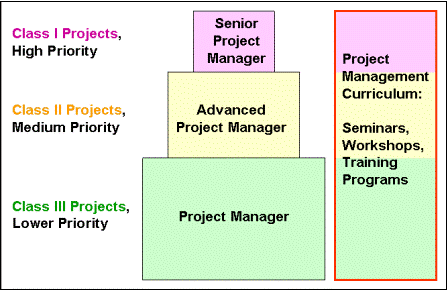


Corresponding to the basics of learning in organizations, it supports and accelerates the natural way of learning by doing, offering a structured system of seminars, workshops and training programs for beginners, project managers (PM's), advanced project managers (APM's) and senior project managers (SPM's).
(3) Main Elements of a Project Management Curriculum
A structured project management training system or curriculum could consist of these main elements (first column), delivered with different methods and intensity on the four consecutive levels of Beginners, PM's, APM's and SPM's (corresponding to the levels of learning, cf. learning in organizations).
CORE ELEMENTS
| Beginners | PM's | APM's | SPM's | |
| Project Management Process | Remember (cf. introductory course) |
Understand and apply | Analyze / evaluate / create | |
| Risk Management | Remember (cf. introductory course) |
Understand and apply | Analyze / evaluate / create | |
| Project Change Management | Remember (cf. introductory course) |
Understand and apply | Analyze / evaluate / create | |
| Project Planning Process | Remember (cf. project planning guide) |
Understand and apply (cf. project planning guide) |
Analyze / evaluate / create | |
| Contract Management | Remember | Understand and apply | Analyze / evaluate / create | |
| Problem Solving Techniques | Remember | Understand and apply | Analyze / evaluate / create | |
| Dealing with Complexity | Remember | Understand and apply | Analyze / evaluate / create | |
| Financing of Projects | Remember | Understand and apply | ||
| Strategy Development and Projects | Remember | Understand and apply | ||
| Sales of Large Projects | Remember | Understand and apply | ||
| Dealing with Crisis | Remember | Understand and apply | ||
| Project Portfolio Management | Remember | Understand and apply | ||
| Project Management Office | Remember | Understand and apply |
PROJECT MANAGEMENT TRAINING - INTRODUCTORY COURSE:
 If you want to get a compact overview of project management, then you use this e-book in pdf-format that introduces the basic PM concepts. It is also a good preparation of classroom training in project management. The e-book contains five lessons, complemented by five tests and a final test, which are integral part of the book. The tests do not only help you to check your learning progress but also enhance your understanding of project management. Together with the e-book you receive a separate answer key for all tests, also in pdf-format. Click here for more info, or
 Alternatively, there is a computer based training (CBT) available which you easily install on your computer and run in your preferred browser. Like the e-book, it is also organized into five lessons, five corresponding tests, and a final test. It takes typically four to six hours to work through the whole course including all the tests.
Click here for more info, or
Alternatively, there is a computer based training (CBT) available which you easily install on your computer and run in your preferred browser. Like the e-book, it is also organized into five lessons, five corresponding tests, and a final test. It takes typically four to six hours to work through the whole course including all the tests.
Click here for more info, or
PROJECT PLANNING GUIDE: A COURSE IN AN E-BOOK
 If you are looking for a textbook covering the complete project planning process, here, we offer you our e-book, Project Planning Guide, in PDF-format. It describes the core planning process in ten steps and contains an example (a photo-voltaic solar plant) to illustrate the application of the explained principles. This e-book complements classroom training on project management. Click here for more info, or
CROSS-FUNCTIONAL ELEMENTS
| Effective Communication | Remember | Understand and apply | Analyze / evaluate / create | |
| Working in Teams and Group Dynamics | Remember | Understand and apply | Analyze / evaluate / create | |
| Self Management and Time Management | Remember | Understand and apply | Analyze / evaluate / create | |
| Leadership Skills | Remember | Understand and apply | Analyze / evaluate / create | |
| Cross-cultural Communication | Remember | Understand and apply | Analyze / evaluate / create | |
| Negotiation Skills | Remember | Understand and apply | Analyze / evaluate / create | |
| Coaching of Team Members | Remember | Understand and apply | Analyze / evaluate / create | |
| Dealing with Conflict | Remember | Understand and apply | Analyze / evaluate / create |
(4) Design and Delivery
An organization can design and deliver training with its own resources, sub-contract it to external vendors, or combine both.
Where ever we need participants to understand, apply or analyze / evaluate / create, predominant format of project management training is classroom training and workshops. There, we can use methods like work on case studies, role plays, simulation, facilitated discussion and best practice sharing, etc. If we focus on delivery of content the participants have to remember, or if we want to train certain basic skills in form of frequent repetitions, we can use computer or web based training. Usually, we integrate these forms into hybrid or blended learning, combining classroom and workshop methodologies with computer or web based approaches.
(5) Mentoring and Coaching
From the perspective of the organization, a very important aspect of
project management training is the aspect of learning transfer:
- How can participants of a seminar or training program transfer their learning into their work environment so that the organization benefits in the predefined way?
- What can the organization do in order to support and guide that learning transfer?
Within a mentoring program experienced staff members, so called mentors, support talents to transfer their learning from seminars into real projects and identify areas of improvement and further learning opportunities. Similarly, independent coaches can help colleagues on all levels to identify their own training needs, learning barriers and blockages and to remove them.
Return to Project Portfolio
Return from Project Management Training to Home Page
|
|
|
Your Comments
Have your say about what you just read! Leave me a comment in the box below.