- Home
- Project Portfolio
- Project Prioritization
Project Prioritization
Published: 2010-10-01
Last updated: 2022-03-16
A well defined project prioritization is important for those organizations which have a clear strategy in place that includes – explicitly or implicitly – the project selection criteria. These organizations need to solve the problem of prioritizing the projects they pursue or already have in their portfolio.
Main Criteria of Prioritizing Projects
(A) Organizational benefits of the project: revenue, cost, profit, and improvement of image
(B) Complexity of the project: necessary expertise, innovative content,
contractual relationships, cross-cultural communication, work in virtual
teams
(C) Risk value of the project: damage to the organization's image and overall risk value
(D) Contract management: expected changes, expected claims against us, or towards others.
(A) Organizational Benefits
|
(1) Revenue |
With revenue we mean the revenue of the project over its whole life cycle, from beginning of our activities, usually in project definition phase, until the end of project closure phase. |
|
(2) Cost |
In a similar way, we consider the total project cost over the whole project life cycle. |
|
(3) Profit |
As project profit we define the delta between its revenue and its cost. |
|
(4) Image Improvement |
Every project we undertake contributes to the overall image of our organization, independent of revenue, cost, or profit. Here, we try to estimate the order of magnitude of how much the project could contribute to the organization's image improvement. For example, a new project could obtain reference character if we complete it successfully. |
(B) Project Complexity
|
(1) Expertise |
Main question we ask here is: how many different areas of expertise do we need to incorporate and coordinate in order to successfully complete the project? |
|
(2) Innovation |
Do we have to create project interim or end results which are innovative from the organization's point of view? |
|
(3) Cross-cultural Communication |
Do we have to work in a team where team members come from different cultural backgrounds? |
|
(4) Virtual Teamwork |
Are all our internal project team members located in the same compound, or do we have to coordinate project work across different sites of our organization? |
(C) Risk Value
|
(1) Image Risk |
What would be our organization's image damage in case of project failure, i.e. we cannot deliver the project result as required, and consequently do not get acceptance? |
|
(2) Overall Risk |
After careful risk analysis and
comparison with similar, already completed projects, we sum up the risk values of the project in order to obtain an overall project risk value. |
(D) Contract Management
|
(1) Contractual Relationships |
What contractual relationships govern the project work? Possible relationships cover a range from single supplier, over single supplier with sub-contractors, tri-angular contract (employer – engineer – contractor), to consortium contract. |
|
(2) Expected Changes |
What are expected revenue, cost, and profit of changes,
based on experience of similar, already completed projects? |
|
(3) Expected Claims Against Us |
What are expected revenue, cost, and profit of claims against us, based on experience of similar, already completed projects? |
|
(4) Expected Claims Towards Others |
What are expected revenue, cost, and profit of claims towards others, based on experience of similar, already completed projects? |
Project Prioritization
For every new project, we estimate each one of these 14 items referring to a preset scale, e.g. 1-2-3-4-5. Thus, we obtain a project-specific prioritization value between 14 and 70. Dividing the interval from 14 to 70 into a certain number of sub-intervals leads to that same number of priority classes.
In case we want to differentiate into three prioritization levels we end up with a picture like this.
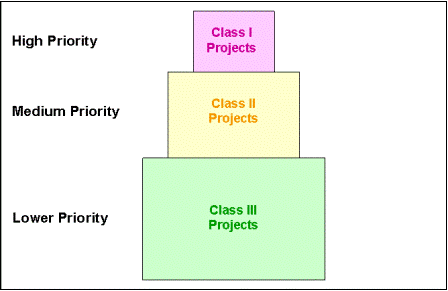

You can adapt this whole prioritization approach to your organization's needs, add or omit items, change the scale into a shorter one, or extend it into a longer one, and adjust the final number of priority classes. We found it best practice to keep the whole system of project prioritization as simple as possible. Thus, effort for communicating and explaining is low, and commitment of all who need to contribute will be much higher.
Weight Factors
In our table above, each item has the same weight. We suggest to critically examine if this applies to your organizational context and the type of projects you are pursuing.
In section Free Downloads, we offer a simplified project prioritization template you can download and adapt to your organization's requirements.
Example
Let us discuss an example in which we use that template with weight factor 1 and a 1-to-5 scale for each item. This means that we could get a minimum score of 14 and a maximum score of 70. Reviewing and evaluating all 100 projects in our organization could lead to the following result:
Project Priority |
III |
II |
I |
Score |
14 … 32 |
33 … 51 |
52 … 70 |
Number of projects |
72 |
19 |
9 |
So, we have 72 projects with priority III, 19 projects with priority II, and 9 projects with priority I. These different levels of priorities reflect the different levels of importance of those projects for our organization. Consequently, we will assign the management of those projects to project managers of corresponding levels of skills and experience. Our project management career model must fit that project prioritization result: we need 9 senior project managers, 19 project managers, and 72 junior project managers.
Change of Strategy – Change of Project Prioritization
In case the organization changes its strategy we need to change the corresponding prioritization criteria accordingly. In general, we do not re-prioritize those projects that are already in implementation phase since this would seriously disturb their execution unless the change of strategy is a fundamental one (like out-carving a significant part of the organization, merging one of the divisions with another internal or external one, etc.).
However, we have to clearly communicate changes of our strategy that implicate changes of our project prioritization to all members of the organization. Only then, all affected project management teams and staff members have a fair chance to understand the change and its consequences. It would be anyway best practice to incorporate the organization's staff into strategy development (cf. section Free Downloads, white paper on "How to Find the Right Projects").
Remark
In some of the project health checks we do, we find a very questionable – if not to say bad – project status especially in terms of project profit. Project managers and their teams explain there was / is no choice but to do that project on a very high priority level because it was declared being a strategic project for the company. In many such cases the project has to be done because it could secure market entry in a certain country or region. We consider the entry into a new market a project itself. Any project that helps us to enter a certain market, thus, becomes part of the larger project "Entry in New Market X".
35+ templates, tools, and checklists in one set
To save you time in your daily work as a project manager, I packaged more than 35 project management templates, tools, and checklists into one zip file.
- You un-zip it, and you get all items in formats you can edit to your requirements.
- They strictly contain only standard functionality and no macros or other code.
- You are allowed to use your logo.
or click here for more info.
Return to Project Portfolio Management
Return from Project Prioritization to Home Page
|
|
|
Your Comments
Have your say about what you just read! Leave me a comment in the box below.