- Home
- Fundamentals
- Triple Constraint
Triple Constraint
Published: 2009-03-10
Last updated: 2022-03-06
The triple constraint of project management describes the interdependency between the three cornerstones of a project:
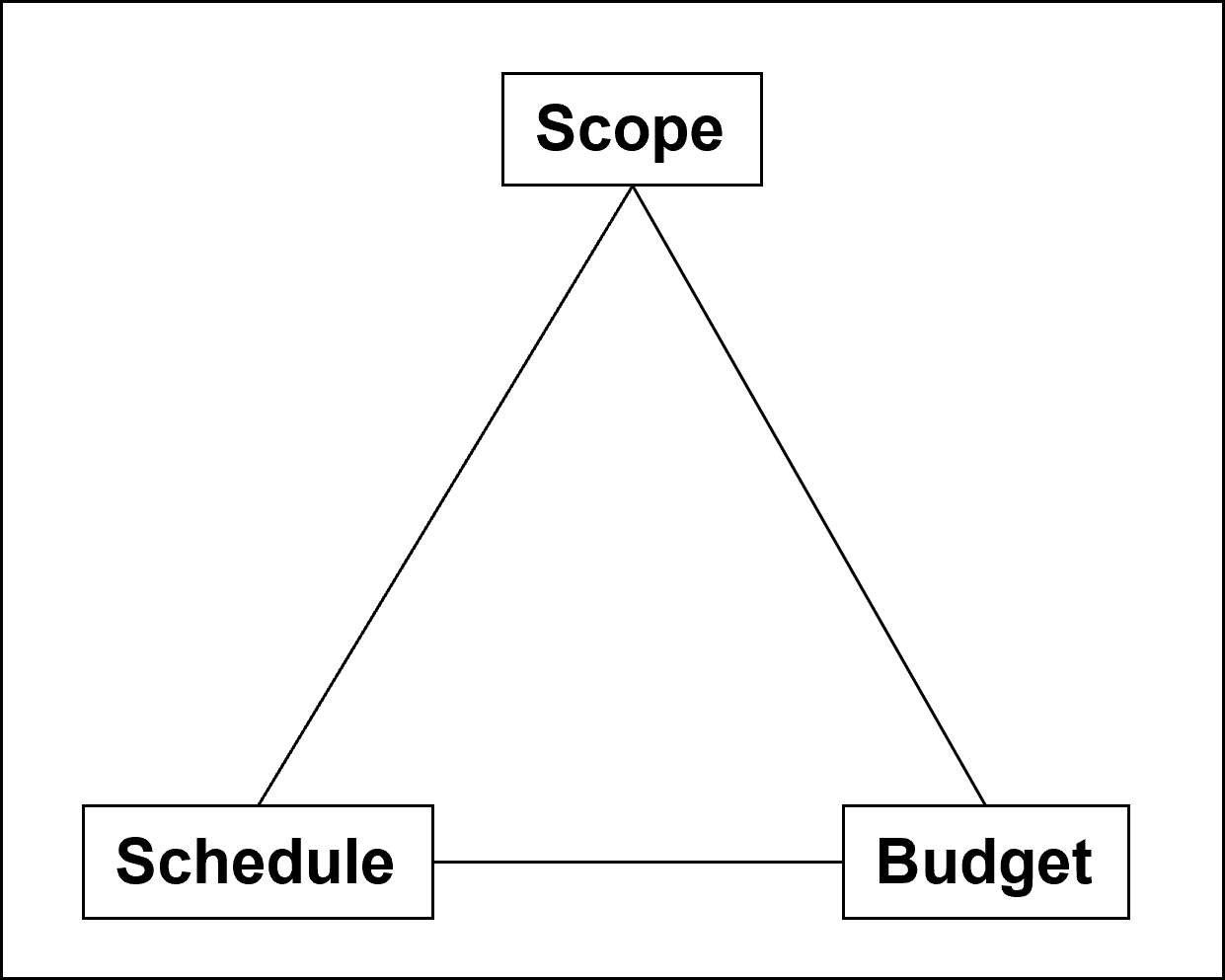

Applying common sense, it seems obvious that changing one of the three cornerstones implies a change of the other two.
- Scope: all the work we have to do in order to create the clearly specified product.
- Schedule: the time we need in order to create that product.
- Budget: the total amount of money we need in order to create that product.
For example, if we increase the scope - because of additionally
required features of the product – then we obviously have to increase
the necessary time and amount of money. Similarly, in order to shorten
the time we could reduce the scope and consequently reduce the budget of
that project. We also could shorten the time by involving more
resources and thus, increasing the budget.
In short, we can say:
A project is defined by its scope, schedule, and budget, and the
triple constraint of project management describes the phenomenon that,
if we change one of the three, we influence the other two.
Looking at it a little bit closer, we find that constraints of project management are mainly limited resources.
- Human resources: there are only a limited number of people with appropriate skill levels.
- Tools: the number of suitable tools is limited.
- Material: the amount of suitable material is limited.
- Money: the budget is limited.
Theory of Constraints
The triple constraint of project management is rooted in the theory of constraints (TOC), first formulated by Dr. Eliyahu M. Goldratt in his book The Goal, published in 1984.
We can measure and control an organization by varying three basic variables: throughput, operating expense, and inventory. Throughput is the money all sales activities generate (simplified: income). Operating expense is money we need in order to ensure the organization's operation on an ongoing basis (simplified: recurring cost). Inventory is money we invest in order to produce and sell goods and services (simplified: non-recurring cost).
Underlying assumption of the theory of constraints is that an organization is limited in achieving its goals by a small number of constraints, and that there is always at least one constraint. A constraint can be internal or external to the organization.
- We seem to have an internal constraint if the organization provides less than the market demands.
- We seem to have an external constraint if the organization provides more than the market demands.
As with the triple constraint of project management, an organization should try to find its constraint(s), and then improve managing them in order to better achieve its goals. More precisely, the theory of constraints suggests:
Step 1. Identify the constraint (those resources or policies that prevent the organization from achieving its goals).
Step 2. Decide how to utilize or change the constraint and its elements to the advantage of the organization.
Step 3. Make sure that all other processes comply with this decision.
Step 4. Raise the constraint (e.g. increase the capacity of the constraint).
Step 5. If, as a result of these steps, the constraint has moved, return to Step 1.
There is much more to the theory of constraints, please refer to the following two sources:
What is TOC?
An Online Guide To The Theory Of Constraints
One application of the theory of constraints is critical chain project management.
35+ templates, tools, and checklists in one set
To save you time in your daily work as a project manager, I packaged more than 35 project management templates, tools, and checklists into one zip file.
- You un-zip it, and you get all items in formats you can edit to your requirements.
- They strictly contain only standard functionality and no macros or other code.
- You are allowed to use your logo.
or click here for more info.
Traditional PM
Learning Path Navigation
|
|
|
Return to Fundamentals of Project Management
Return from Triple Constraint to Home Page
|
|
|
Your Comments
Have your say about what you just read! Leave me a comment in the box below.