- Home
- Fundamentals
- Project Management Models
Project Management Models
Published: 2009-03-12
Last updated: 2022-03-19
There are different project management models. Across this whole web site we use the project management life cycle as presented in the section The Fundamentals of Project Management. It is a linear process model consisting of four phases.

In this picture it looks as if the four phases did not overlap. In real life, they often do but we simplify for the sake of clarity of our presentation.
This project management process model with non-overlapping phases corresponds in fact to the waterfall model of which you find a small case study here.
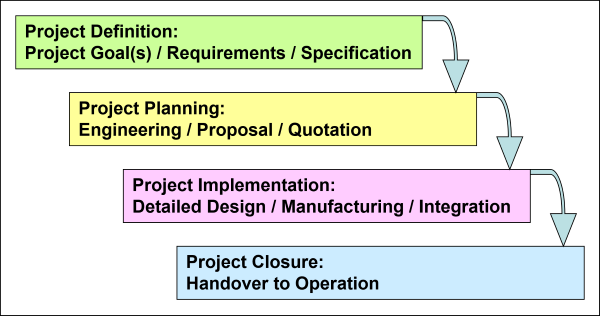
The waterfall model is based upon the principle that one phase cannot start until the previous one is completed. For example, in a typical construction project, we cannot start implementation phase until approval of all planning documents is done, i.e. planning phase is completed. In fact, to one extreme, this model does allow for overlapping phases, in that one phase cannot be finished until the previous one is finished.
In contrast to this linear model, we have an iterative model, the spiral model of project management.
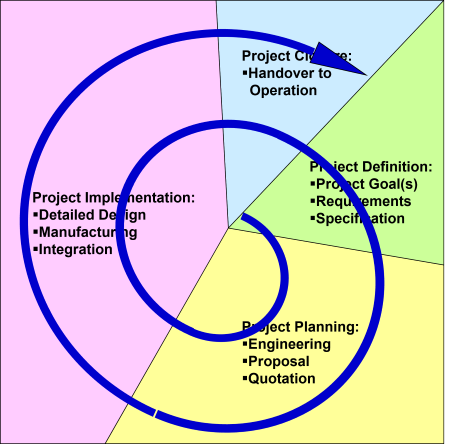


The spiral model is based upon the principle that we go through the different phases again and again, until we reach a certain degree of maturity of the product to be created which e.g., a customer can accept. It is even possible that one part of our project is still in definition phase while another one is already in implementation phase. Typical examples of this iterative approach would be IT projects, i.e. the design and development of products and services in the IT industry with its short innovation cycles and high probabilities of changing requirements during implementation phase. See also the sub-section Managing IT Projects.
Most of our real life projects seem to be mixtures of these extreme approaches, with some sub-projects following more the waterfall model principles, others following more the spiral model principles.
35+ templates, tools, and checklists in one set
To save you time in your daily work as a project manager, I packaged more than 35 project management templates, tools, and checklists into one zip file.
- You un-zip it, and you get all items in formats you can edit to your requirements.
- They strictly contain only standard functionality and no macros or other code.
- You are allowed to use your logo.
or click here for more info.
Traditional PM
Learning Path Navigation
|
|
|
Return to Fundamentals of Project Management
Return from Project Management Models to Home Page
|
|
|
Your Comments
Have your say about what you just read! Leave me a comment in the box below.